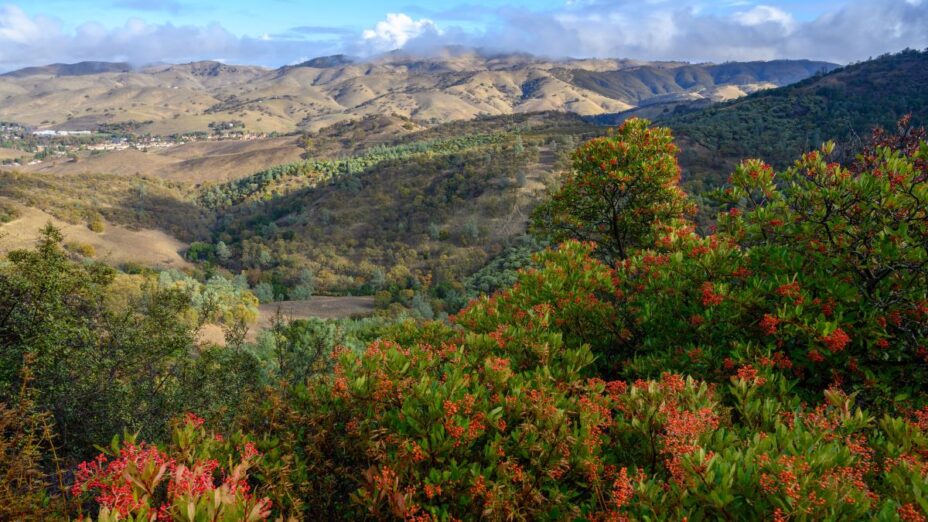
In May of this year, Save Mount Diablo learned that there was a proposal to annex about 41 acres of land bordering Clayton’s east side into the City of Clayton.
This proposal was concerning for many reasons, including habitat loss, very high fire danger, and defense of the Urban Limit Line, but not unprecedented. Developers typically want to add land to cities so that their projects access more services and fetch higher prices.
But what surprised us about this project was that the City of Clayton had no idea it was happening.
Strange from the Start

Donner Canyon’s biodiverse chaparral ecosystem, near the Moita property. Chaparral vegetation is highly flammable. Photo by Scott Hein
The owners of this unincorporated county land, the Moita developer family, had submitted an application to the Contra Costa Local Agency Formation Commission (LAFCO) to have their land annexed and become part of Clayton.
This application was unusual because a private entity made the proposal. What almost always happens in cases like this is that a local agency, like a city, submits an application to LAFCO to have land annexed into the city.
The annexation then normally only happens after lengthy consultation and agreements with the city are signed, if it happens at all.
In this case, it seemed the Moita developers were asking LAFCO to approve their proposal, so they could later tell Clayton that the city has no choice; now that it’s approved, they must annex the Moita land.

The area can be seen from atop Mount Diablo’s Twin Peaks. Photo by Scott Hein
What makes this proposal odd was that the city had no idea that a proposal had been made to LAFCO.
If it hadn’t been for other entities, including Save Mount Diablo, alerting the city, the City of Clayton wouldn’t have even known the application for annexation was happening.
And yet, taking in new land entails many associated costs and risks for Clayton.
To quote letters from Clayton to LAFCO, “To be clear this application is not in collaboration with the City, therefore, the City was completely taken by surprise to hear about the LAFCO meeting.”
This situation was unusual, and and at odds with best practices regarding due process and guidelines designed to avoid these situations.
Putting aside the many obvious pitfalls of proposing development here, the confusion and uncertainty surrounding this process made it a high priority to defeat.
In our advocacy, Save Mount Diablo oftentimes simply asks developers to follow the rules, and in this situation there was massive confusion and disagreement about if they had been followed.
Undermining the Urban Limit Line and Adequate Environmental Review

Steep slopes in Donner Canyon, near the Moita property. Photo by Scott Hein
This proposal was coming before LAFCO just a month before Contra Costa Measure A, the measure to renew Contra Costa County’s Urban Limit Line, was decided at the ballot box by county voters through the election in early June.
Contra Costa County voters were about to decide on updating the Urban Limit Line, and that process needed to play out before the project was considered.
At the time, the vast majority of land that Moita developers wanted to annex was outside both the county’s and Clayton’s Urban Limit Lines, lines beyond which urban-style development like what the developer had in mind cannot occur.
It would be profoundly destabilizing to the Urban Limit Lines as a land use tool to consider an application for annexation outside both the county and Clayton’s Urban Limit Lines for the purposes of growth, and contingent on an Urban Limit Line change sometime in the future.
The Moita proposal would have undermined the Urban Limit Line as the effective and crucial land use tool that it is.
In addition, the Moita application tried to rely on a vague plan written in 1995 for its environmental review. This review would clearly have been inadequate because after more than 30 years, environmental conditions and the built environment in the area have drastically changed.
The realities of climate change, newly listed wildlife species, and the impact to services of the project in the era of super-charged, climate change–fueled wildfire all pointed to the need for updated environmental review.
The Worst Place to Develop

The Morgan wildfire on Mount Diablo in 2013. Photo: Stephen Joseph
The land the Moitas wanted to annex is a fine example of the worst place to build if California and the communities of Contra Costa County are to solve the overlapping and mutually reinforcing crises that we face: affordability, fire, and climate change.
The country-estate, large-lot, mansion-like development envisioned is the least affordable kind of development imaginable.
Its location beyond the urban edge, far from existing services, would also make car ownership a necessity, further increasing the costs associated with living in this location.
The high cost of insuring a house in this zone, the most severe classification of fire hazard that exists, is more reason that development here would not improve housing affordability in the region one bit.

The Moita property is located in a Very High Fire Hazard Severity Zone. Map: CALFIRE (Moita property boundary added by Save Mount Diablo)
As the map shows, the project site is entirely within, and completed surrounded by, a Very High Fire Hazard Severity zone. As clearly mapped by CALFIRE above, these areas are the most likely to burn, and therefore the least suitable for development.
Building there not only risks the property and lives of the residents that would live in these houses, but it also increases the threat of fire for existing adjacent neighborhoods in Clayton.
It seems obvious that building neighborhoods there should be avoided as a simple tenet of public safety.
The site is as far as you can get from job and transit centers, increasing car dependence that would most likely worsen climate change through emissions produced by gasoline-fueled vehicles.
Continuously building beyond the urban fringe perpetuates a vicious and destructive cycle:
- reliance on carbon-polluting vehicles,
- increasing consequences and impacts of human-caused climate change,
- increasing development in areas most and increasingly likely to burn, and
- destruction of these developments emitting carbon pollution into the atmosphere, further exacerbating climate change.
Our region would be much better served by following the principles of sustainability, reduced car dependence, increasing transit, and increasing the safety of our neighborhoods.
The key is to focus development on areas that increase affordability, minimize carbon pollution, and provide alternatives to car dependence.
Achieving Victory

View of Donner, Back, and Mitchell Canyons in Mount Diablo State Park from the Krane Pond property. The Moita property is located in this same area. Photo: Cooper Ogden
What did Save Mount Diablo do to defeat this ill-conceived proposal?
We talked to county leaders about the issue and submitted formal comment letters highlighting the danger to the Urban Limit Line, existing communities, and sound land use planning if this project were to advance.
We also attended and commented at all of the three meetings LAFCO held on this project, reminding Commissioners of the pitfalls of this location, as well as the confusing and unusual way the Moita developers had submitted their proposal.
The local agency accepting an annexed area should not only be aware of a proposal like this one, but also be in agreement with it, and normally submit the proposal themselves.
Both Clayton leadership and city staff repeatedly let LAFCO know that what the developer was doing had not been discussed with or approved by the city. This situation was clearly not an example sound land use planning.

Mount Diablo State Park’s popular Falls Trail travels through Donner Canyon near the Moita property. Photo by Scott Hein
Save Mount Diablo also spearheaded the Yes on A campaign, and we won in a landslide of more than 70 percent in early June. This electoral success brought the Moita property entirely outside of the county’s Urban Limit Line.
Finally, at their August meeting, LAFCO Commissioners voted six to one to deny the Moita annexation proposal.
We thank Mayor Gabe Quinto, Vice Mayor Marisol Rubio, Supervisors Andersen and Burgis, and Commissioners Lewis and McGill for their reasoned decision.
Save Mount Diablo will remain vigilant should the developers try again, and we will work with partners to uphold good land use policy and sensible planning to protect the natural and human communities of Contra Costa County.

