
Hospital Canyon Larkspur
From a cluster of dark starburst-shaped leaves stands a tall string of fuzzy pink flowers. This impressive plant is known as Delphinium californicum ssp. interius or Hospital Canyon larkspur, and it’s one of the Diablo Range’s special rare plants.
It’s a California native limited to the Diablo Range, and it is considered rare and moderately threatened in the state by the California Native Plant Society.
It’s also found, among other places, in Save Mount Diablo’s protected Mangini Ranch Educational Preserve.
Biodiversity in Mangini Ranch Educational Preserve
Open to the public only by reservation for educational purposes (reservation is free), this preserve safeguards a variety of habitats and native plants.
You can find riparian (streamside) species, grassland, oak woodland, and slopes of chaparral. It’s an excellent place for research.

Mangini Ranch Educational Preserve. Photo by Al Johnson
Recently, the preserve caught the eye of Clare Loughran, Curator and Conservation Officer with the University of California Botanical Garden at Berkeley.
The preserve “has those classic East Bay rolling hills of pretty steep terrain that is primarily dominated by nonnative grasses—but with a lot of these East Bay lands, there’s a lot of these really cool natives that come up in these grasses, too,” she pointed out.
She discovered that, according to the California Plant Rescue database of conservation seed collections, Hospital Canyon larkspur was underrepresented: a great opportunity.
Save Mount Diablo and the University of California Botanical Garden at Berkeley: Botanical Research Partners
With both permission and funding from Save Mount Diablo’s Dr. Mary Bowerman Science and Research program, Loughran and her colleagues Sophia Warsh and Jon Nord Kanagy took on the project.
They decided to locate this local larkspur population, document it, and collect seeds.
If successful, the team would return with enough knowledge to update state records; keep documentation for the University Herbarium; and store two separate collections of seeds for safekeeping, study, and restoration efforts.
The University of California Botanical Garden at Berkeley is well equipped for such studies, making it a great partner for botanical research to aid Save Mount Diablo’s mission.

The University of California Botanical Garden at Berkeley
The botanical garden harbors a world-renowned plant collection of more than 10,000 kinds of plants, including many California native rare and endangered species.
It’s a unique experience for visitors, as well as a valuable resource for researchers, UC Berkeley faculty, students, and staff.
Searching for the Rare Larkspur
This project, however, was not a guaranteed success.
Several questions remained unanswered. How big a population still existed at Mangini Ranch? Could this population provide enough seeds without compromising its overall seed supply?
To begin, Loughran and Warsh trekked into Mangini Ranch in search of the larkspur. “Sometimes when you have coordinates, it still feels like a needle in a haystack,” Loughran explained.
However, “I know these are super tall plants, so if they’re there, I’ll be able to see them. And if the timing is right, they’ll be obvious,” she noted.

Hospital Canyon larkspurs. Photo by Scott Hein
With some work, they were able to spot the rare larkspur among its favorite habitat: chaparral vegetation.
However, the area was guarded by hardy shrubs that made wading in a bit daunting. Loughran admitted, “I think it’s possible that chaparral areas are understudied, because they’re a little bit hard to infiltrate.”
She was not deterred—eventually, they found an approachable path. What’s more, the population turned out to be a suitable size for collection, which was a huge relief.
But a new issue had come up: the plant wasn’t keying out as the right subspecies.
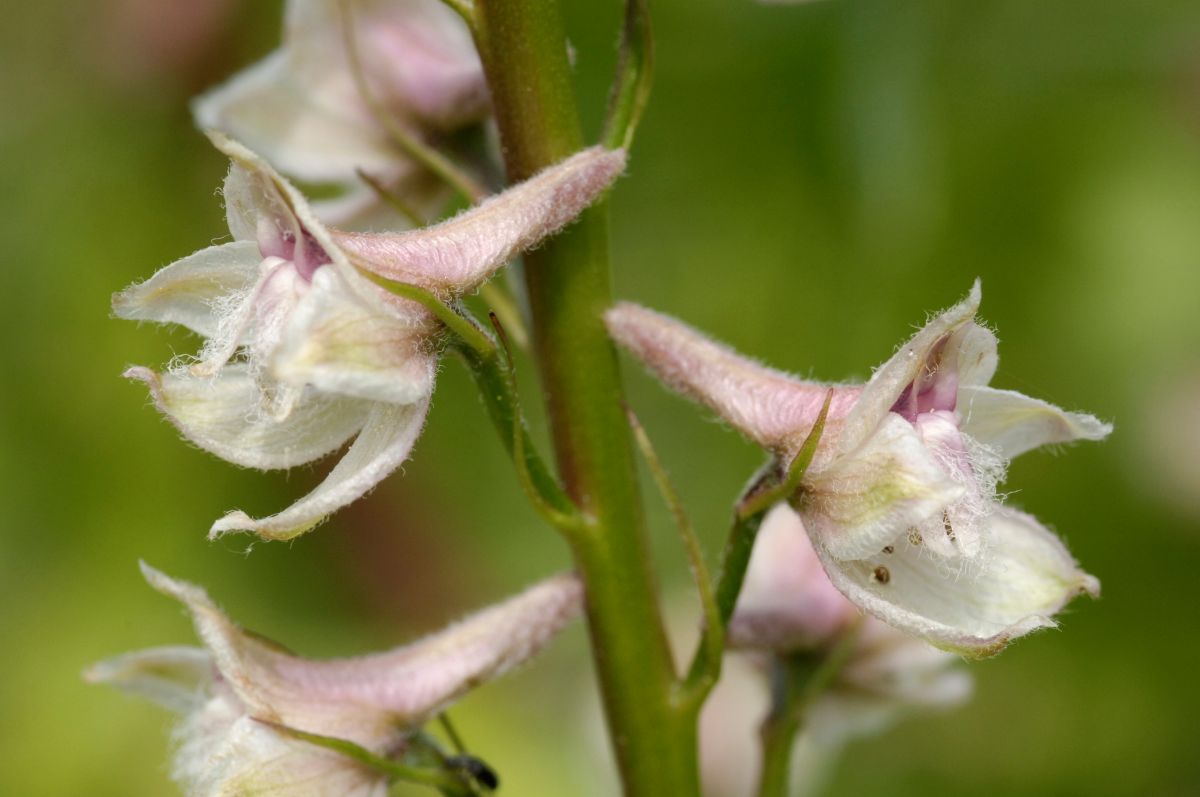
The Mount Diablo area produces a puzzling kind of Hospital Canyon larkspur. Photo by Scott Hein
Unique Characteristics Found around Mount Diablo
“One of the things that we were seeing was that the lower lip petals were hairy, and they weren’t really supposed to be hairy for this subspecies. But some of the other characteristics were fitting better with the subspecies than the other subspecies.”
Some reading revealed that Delphinium californicum ssp interius, the targeted subspecies, is known to display intermediate characteristics in the Mount Diablo area.
“This is actually showing a whole new set of genetic material that could also be seed banked. Maybe there is something special that’s going on around Mount Diablo,” Loughran considered.
With that, the team got to work documenting the characteristics of the plant.
Using a plant press, they carefully preserved a whole flowering plant for future study. The pressed larkspur helps create an herbarium voucher for the University Herbarium.
The accompanying detailed documentation also serves to update statewide records of the subspecies. With that done, it was time for seed collecting.

Clare Loughran, Curator and Conservation Officer with the University of California Botanical Garden at Berkeley, on-site at Mangini Ranch Educational Preserve. Photo by Sophia Warsh, Assistant Curator at the University of California Botanical Garden at Berkeley
Conservation Seed Banking of the Hospital Canyon Larkspur
In June 2026, the team revisited the larkspur population for the important task of seed collection. They followed thoughtful guidelines to preserve not just the collected seeds, but to also protect the existing population of larkspurs.
For example, best practices dictate sticking to maternal lines to avoid impacting the population’s gene pool and only collecting under 10 percent of the population’s available seed set.
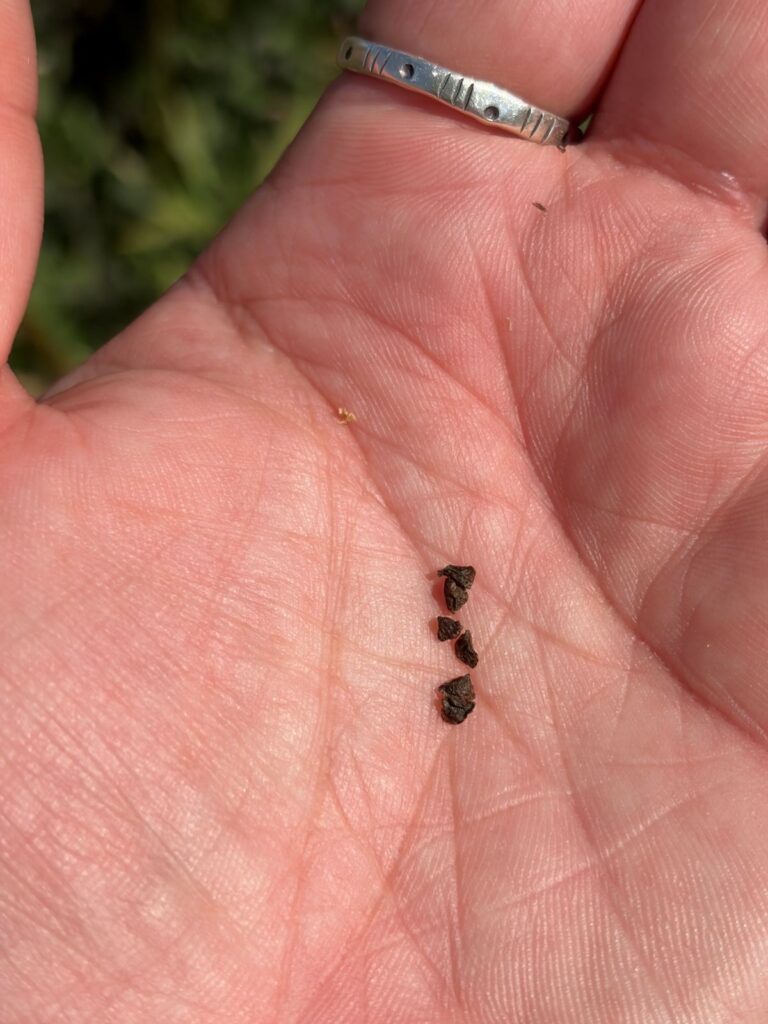
Tiny Hospital Canyon Larkspur seeds. Photo by Clare Loughran
The seeds, once collected and processed, were then split into two groups.
These groups were stored in separate locations; if a fire or other damage wiped out one, this practice ensures that the other seed group will survive.
All in all, Loughran’s team was ultimately able to collect seed from about 100 plants, forming a complete conservation seed collection that can support future research and restoration.
Why It Matters: Restoring Rare Plant Species on and around Mount Diablo
While being a general accomplishment for conservation, this successful seed banking project also has direct benefits for Save Mount Diablo.
From milkweed at Curry Canyon Ranch to California pipevine at Marsh Creek 7, the Save Mount Diablo team is often planting rare species as part of its land conservation mission.
In the future, Hospital Canyon larkspur could very well be one of them.

