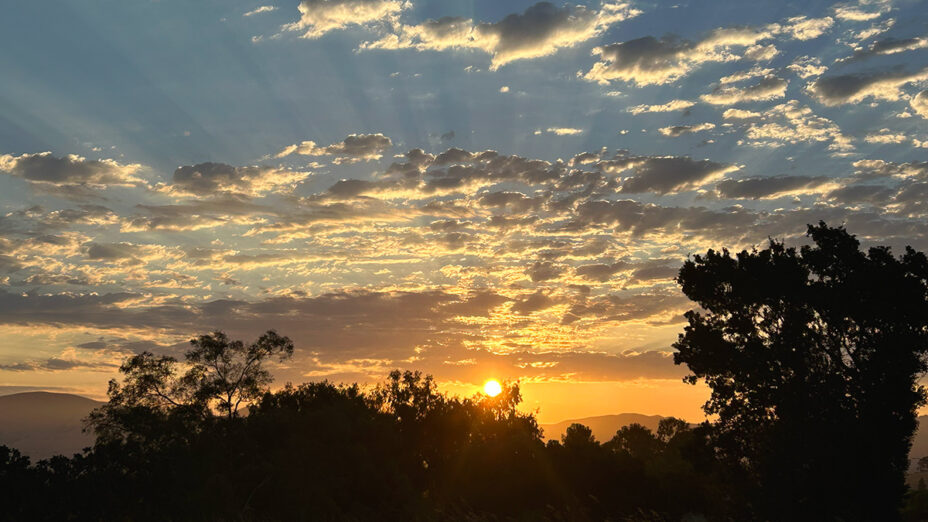
A Sunrise in All Its Glory
We’re often so busy that we forget to hear the morning birdsong or watch a brilliant sunrise.
Luckily, I was able to start my Saturday with both, thanks to a special Save Mount Diablo outing.
Members of our community came together at 7:00 AM in Mangini Ranch Educational Preserve for a meditation hike led by the wonderful Sharon and Jim Lawrence.
The journey there was worth it in itself: as we arrived, a stunning display of color bloomed across the sky, the roads still quiet and empty. I hadn’t seen a sunrise like that in ages.
Thanks to the early hour, it was almost chilly. Puffy clouds drifted overhead in the crisp breeze as we chatted.
With the sky just brightening, it was hard to imagine that we would return only hours later to a sunny summer day, with several miles behind us and a whole new mindset.

Discover Diablo participants come from all over Contra Costa County, even for a 7:00 AM start. Photo by Emily Sherwood
What Is Nature Meditation, and How Does It Work?
Our guide Sharon is well-versed in many kinds of mindfulness and meditation. Before we entered Mangini Ranch Educational Preserve, she thoughtfully explained the benefits of meditation and forest bathing.
Essentially, both serve to reduce stress and improve our health. The science, she said, is beginning to substantiate what any outdoors enthusiast will tell you: nature is a powerful healing influence.
Whether we prefer hiking, sauntering, or nature meditation, all are outdoor experiences that are beneficial for our health. According to one study, even five minutes of looking at nature scenes helps to calm our nervous system.
Nature meditation doesn’t need to involve hiking at all, but we can meditate while we hike, if we do it slowly and deliberately.
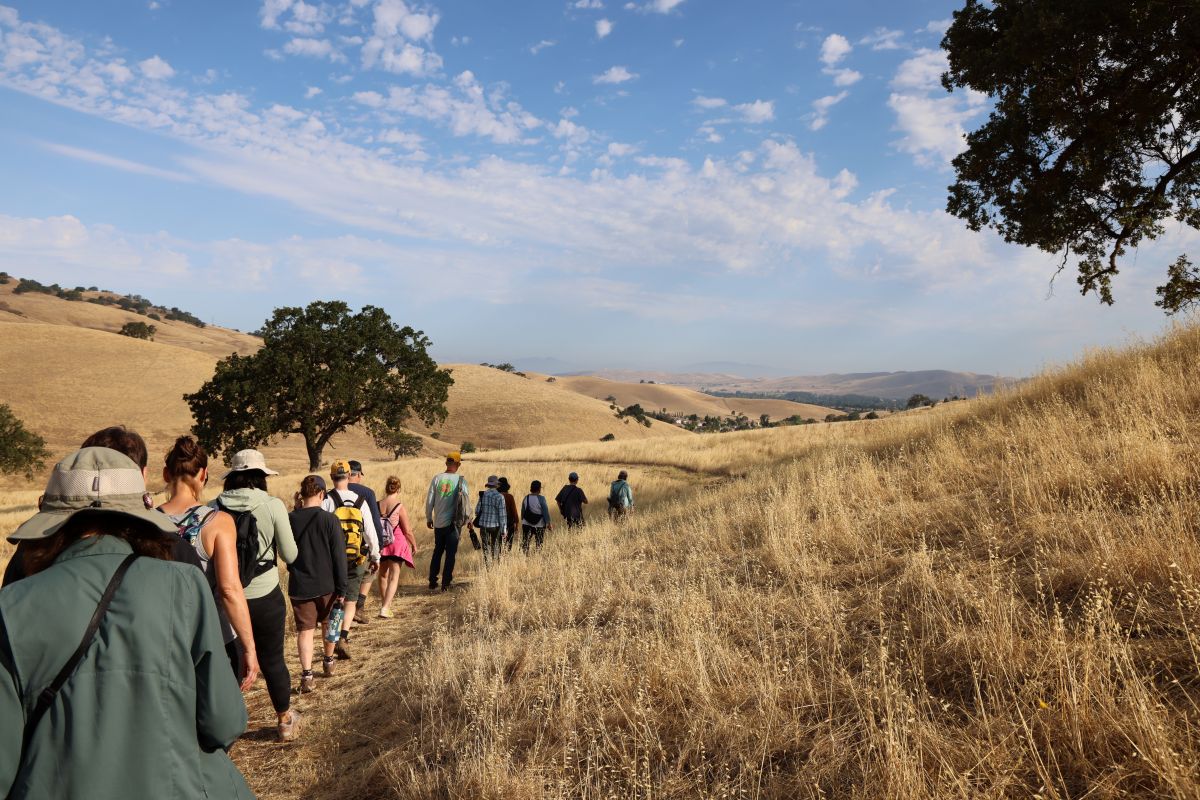
Walking meditations are easy to do alone or with a quiet group. Photo by Emily Sherwood
Types of Walking Meditation
One way to hike mindfully is by counting your steps.
Sharon advised us to count in sets of 10, focusing on the feeling of the earth under our shoes with each step. Our minds tend to wander when we do this. That’s OK, she said. We just need to guide our thoughts back.
When we walk quietly, the sounds of the landscape come to life. Small noises of wildlife are everywhere underneath the sound of wind through the grass.
Later that morning, we switched to a hiking meditation that prioritized broad awareness.
Unlike focusing on steps, she encouraged us to notice each element of our surroundings. Enjoy the beauty of a shrub, a beetle, or a cloud. Move on.
The key to this exercise is to absorb sights without analyzing them, although this process can be more difficult than we might think.
If we see a beetle, but don’t like bugs, we might struggle to appreciate their iridescent shell or the casual way they amble over the dirt.
This exercise does get easier with practice, and I found it the most enjoyable walking meditation.

Participants walk through Mangini Preserve’s oak woodland. Photo by Emily Sherwood

Early on, we spotted a family of turkeys in Mangini Preserve. Photo by Emily Sherwood
Types of Still Meditation
Meditation tends to slow our steps, and eventually Sharon gathered us under the trees for an entirely still meditation.
“Connect with a tree, a branch, even a little patch of grass,” she said, and instructed us to absorb everything about it for several minutes. We quickly began to understand how long each minute could be.
That time of quiet reflection feels like a portal. We could hear the woodpeckers; the woodland was serene.
A small part of the tree canopy is amazing when we fully appreciate it. As we studied, the whole group fell so quiet that we could forget anyone was there.
Once the meditation was over, everyone spoke softly, feeling at least a bit spellbound.
Sharon then brought us to a gathering place deep in Mangini Preserve for a guided energy meditation.
Her experience was evident, aiding the group with a guided muscle relaxation and rich visuals that brought our focus through our bodies to think about things around the world and back again. It was a transformative experience.
Afterwards, we returned to our senses feeling refreshed.

You don’t need vast landscapes to lose yourself in nature’s beauty. Photo by Emily Sherwood
Create Memories in Nature
As we began the hike out, the sky was finally full of sun. The views unrolled ahead of us. Beyond each rise of whispering grass peeked distant purple hills.
Sharon eventually stopped us by an ancient oak tree. “Look around,” she encouraged, “and begin to etch this moment into your memory.”
She cited a study showing athletes can improve their performance using visualization, and explained to us that our brains often treat mental imagery like real, physical stimuli.
By creating “a memory bank” of this soothing moment, we can effectively re-experience it later.
So we took in the breeze, visually traced the tree’s cool blue shadows, or touched its raspy bark, and let it sink in.
I have enjoyed coming back to that moment since.

Dry grass glows like paper lanterns in morning sunlight. Photo by Emily Sherwood
Experiencing Heritage Landscapes
By filling our memory banks with nature, we can self-soothe during hardship. We know it’s healthy to form frequent experiences in nature. It also serves to remind us of the value of conservation.
Importantly, to continue conserving these special places, we need to also appreciate them.

If we protect local landscapes, we encourage the nature experiences that protect our health. Photo by Emily Sherwood

