
Providing an Expert Look at the Diablo Range

Joseph Belli lives in the heart of the Diablo Range. Photo by Scott Hein
A Life Rooted in the Diablo Range
Joseph Belli’s fascinating life story has unfolded alongside the little-known and vastly underestimated Diablo Range.
Growing up in his family’s house nestled in the foothills provided Joseph with the opportunity to explore the Diablo Range from a very young age.
Now as the author of two books, The Diablo Diary and Beneath a Black and White Sky: A Year Among Condors at Pinnacles National Park, he thoughtfully illuminates it.
Belli graduated with a degree in conservation biology from San Jose State University and spent time surveying Diablo Range landscapes and wildlife while working for the National Park Service.
He also volunteers with the Pinnacles National Park condor recovery program and has extensive experience with amphibians and reptiles.

Belli has spent countless hours locating all sorts of Diablo Range wildlife. Photo by Joan Hamilton
The Story behind The Diablo Diary
The Diablo Diary offers more than two dozen natural history essays that delve into the range’s intriguing and imperiled creatures.
Here, Belli shares his passion for California tiger salamander and horned lizard as much as the more famous mountain lion and tule elk. He has spent seven years surveying for red-legged frogs, and as a result, has walked a thousand miles in Henry W. Coe State Park.
Environmental threats impact all these species to some degree: the pressure of invasive species, encroaching development and habitat loss, climate change, government policies.
Humans also have their own struggles. Woven throughout the book are Belli’s own hopes and challenges. He writes as easily with gravitas as he does with levity, which makes The Diablo Diary both engaging and welcoming.
Readers of The Diablo Diary will learn about areas all over the Diablo Range, from Mount Hamilton to Pacheco Pass, Pinnacles National Park, Panoche, and New Idria.

Pinnacles National Park. Photo by Sean Burke
Charmed by Panoche
Thanks to a strong friendship with one of the Panoche region’s few residents, he’s returned to that area often. Wildlife there is elusive, though. Each glimpse has been another testament to their resilience in this arid landscape, and he finds himself in awe.
The Bureau of Land Management hired him in 2009 to survey for endangered blunt-nosed leopard lizards—even in the summer heat of Panoche, which reached over 110 degrees.
There were vanishingly few lizards to be found, but nonetheless he sought diligently along ephedra bushes and burrows.
He also returned to conduct a genetic study of yellow-backed spiny lizards. This research meant capturing them for DNA sample collection—a feat which he managed with a professional noosing pole and some dental floss.
He was well served by his childhood of catching lizards.
He has now traveled all over the Panoche region in search of spiny lizards.

A yellow-backed spiny lizard in the Panoche region. Photo by Joseph Belli
A Condor’s-Eye View
Belli kept field notes throughout 2017 while volunteering for the Pinnacles condor recovery program, which ultimately evolved into the book Beneath a Black and White Sky. He knows the story of condors inside and out and has spent thousands of hours tracking them.
Beneath a Black and White Sky explores the intricacies of reintroducing this endangered species. From daily management tasks to ongoing controversies, Belli opens up the world of saving California condors through a lens like no other.
Since the 1990s, Belli has lived in Pacheco Pass, between Henry W. Coe State Park and Pacheco State Park.
The California Department of Fish and Wildlife has identified SR-152 in Pacheco Pass as a top priority barrier to wildlife movement (top priority to address the harm it does).
To reduce roadkill, enhance public safety by reducing wildlife-vehicle collisions, and increase wildlife movement across Pacheco Pass, the Santa Clara Valley Habitat Agency is spearheading an effort to construct a wildlife overcrossing in this area.
Belli lovingly refers to his home as the “Pacheco Pass Wildlife Research Station.”
With a variety of wildflowers, grasslands, and oak woodland habitats, it also boasts beautiful views of Pacheco Peak and Quien Sabe.

A view toward Pacheco Peak, whose towers are an occasional roosting site for condors, from Belli’s property. Photo by Scott Hein
Protecting the Future of the Diablo Range
Joseph Belli has signed an agreement to preserve his special property with Save Mount Diablo. Both see the importance of this beautiful part of the Diablo Range, so together are currently working to protect this critical linkage from future development.
Belli says, “When I purchased the property in 1992, my long-term goals included not only preserving the land but opening it up to conservation-oriented research. I even gave it a name: the Pacheco Pass Wildlife Research Station, which I envisioned serving as a hub for ecologists, botanists, and wildlife biologists studying the natural history of the Diablo Range. So far I’ve been the sole researcher here, but my hope is that this project with Save Mount Diablo will provide access to researchers within the Save Mount Diablo community, and I’m very excited about that.”

Joseph Belli and Ted Clement, Executive Director of Save Mount Diablo. Photo: Scott Hein
Belli also serves on Save Mount Diablo’s Advisory Council as a trusted expert on the Diablo Range.
He continues to be a key advocate for the Diablo Range, leveraging his incredible experience with artful prose and a welcome sense of humor.
If you would like to read the stories of this spectacular mountain range from the perspective of an accomplished conservation biologist and storyteller, his books are available for purchase online.
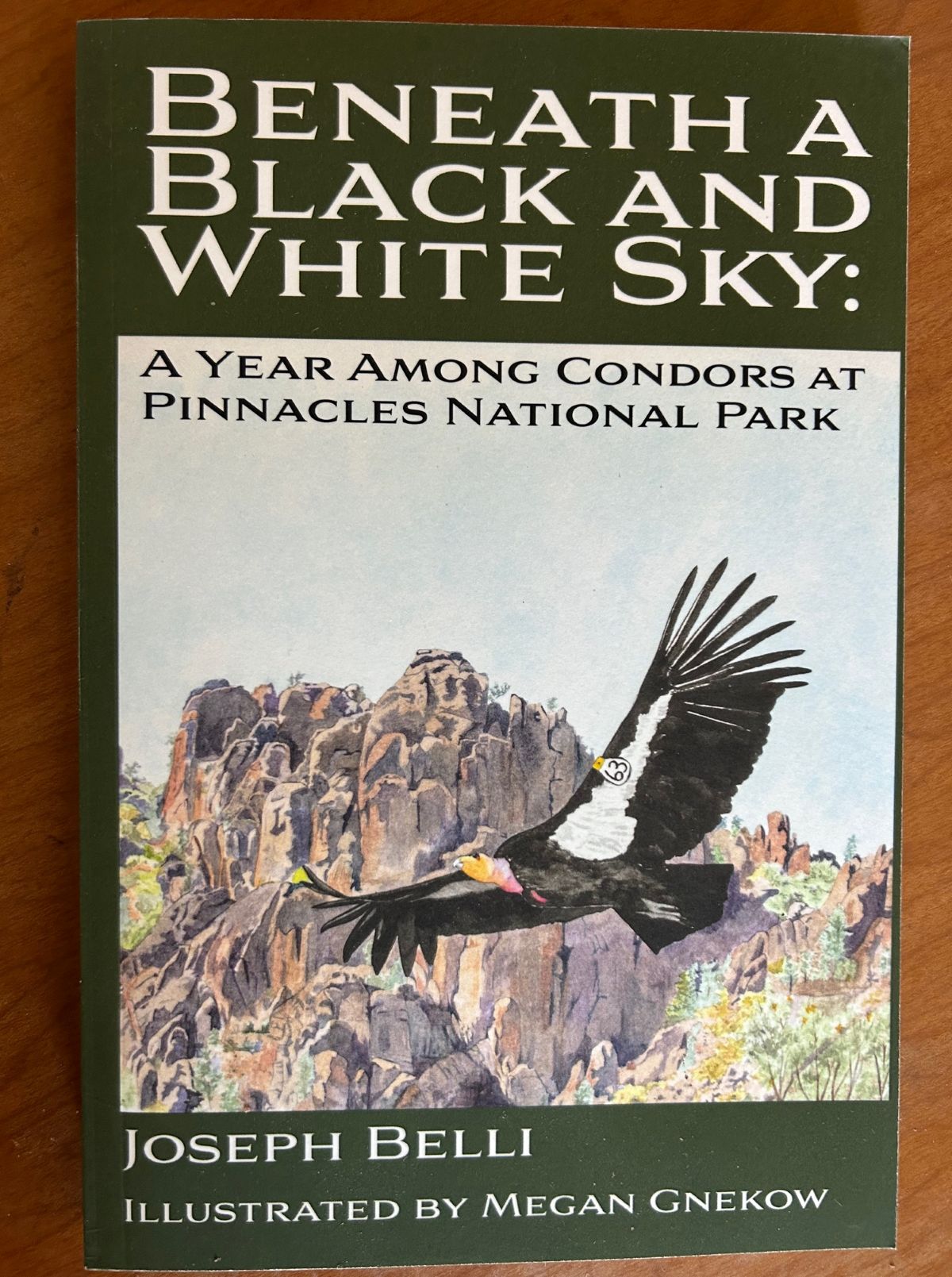
Beneath a Black and White Sky: A Year Among Condors at Pinnacles National Park by Joseph Belli

